By Isabella Bercan
Dominican University is quite unique when it comes to the American higher education system. You can have universities such as Harvard or Princeton who depend on billion-dollar endowments, but the reality here is our school which is a small, Catholic, private, Hispanic-serving institution is much more grounded and dependent on the individual students that choose to attend Dominican University every year.
A recent interview was held pertaining to Dominican’s fiscal health with Mark Titzer, the Chief Financial Officer in the Business Office, who gave a clear perspective at the complexity of keeping our campus running. Whether it be the “sticker price” of tuition to the looming concern of federal policy, Titzer explained how the university must navigate all of this to ensure its doors remain accessible to the students who need it the most.
Titzer explained that “the university’s budget, or targeted operating revenue, is about $100 million”. Though, the school barely sees that full amount. Instead, about $50 million nearly half of the budget is immediately directed back to the students in the form of need-based scholarships and merit.
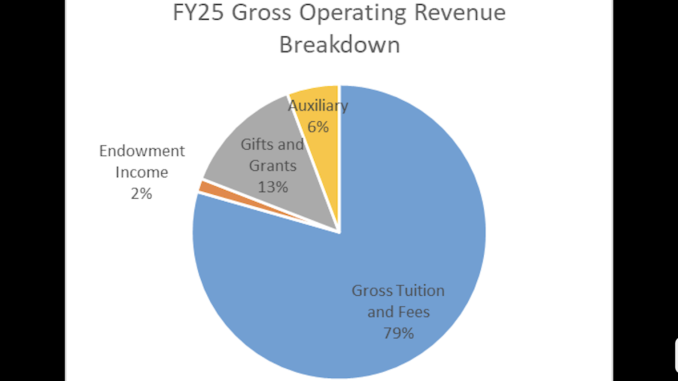
The “discounting” as many like to refer to it is routine for tiny private institutions. As Titzer stated, “a high sticker price kind of connotes to the public… good value or prestige and a high scholarship connotes, well, we really want you to come here because we think you’re so smart”. Once the scholarships are considered, gross tuition and fees still account for a significant 79% of Dominican’s gross operating revenue for the 2025 fiscal year.
Because the university is very tuition-dependent, the financial stability of the students corresponds with the stability of the university. Titzer clarified most Dominican students are not paying what is left on their bill out of pocket; instead, they depend on various “legs of a stool” which make education at Dominican affordable. Federal Pell grants are a critical lifeline for low-income students, which Titzer stated can “award you up to almost $8,000”.
Then there are MAP Grants which are specific to in-state students; Titzer also stated that “…most of our students qualify for a map grant” and “many of them wouldn’t be able to afford to go here” without it. Then there are federal loans which are currently rooted in a national debate; loans continue to be a necessary resource for many to fill in that final gap in the tuition bill.
“The funding we get from the federal government is the most material funding that we get,” Titzer said, spotlighting that the money comes to the university “via our students, or goes to the students via us”.
Being a designated Hispanic-Serving Institution (HSI), Dominican is dedicated to supporting a diverse student population, though this status also delivers concerns because of the current political climate. The HSI designation aided in securing more federal money during the COVID-19 pandemic years; it does not by default boost individual Pell Grant awards.
Titzer shared there is “a lot of anxiety and fear” regarding federal support for Diversity, Equity, and Inclusion (DEI) initiatives. Of course, Dominican continues to be committed to these values as part of its mission, Titzer stated, “We’re certainly not going to try and go to war with the federal government over those things”. Core programs such as Pell and MAP seem to have been spared from initial cuts, but Titzer indicated that “the federal government has stopped the direct loan program for graduate students,” which does impact some students on campus.
You could say funding is the lifeblood of Dominican and enrollment is the heart which pumps it. Undergraduate enrollment is the highest we have ever seen. Though Titzer shared that this growth can bring some challenges. There are only 30 acres of land at the River Forest campus; the school needs to balance the necessity for revenue and the actuality of limited resources. “There’s only so many parking spaces here and bathrooms and…lines for a sandwich kind of thing,” Titzer stated.
While Dominican proceeds to face towards the future, its fiscal health continues to be a joint effort of varied revenue streams. Preserving this balance guarantees that the school can keep serving as a crucial resource for the student body and the community overall. Dominican’s mission never wavers which is a dedication to offering an obtainable education to all.