
By: Santiago Torres
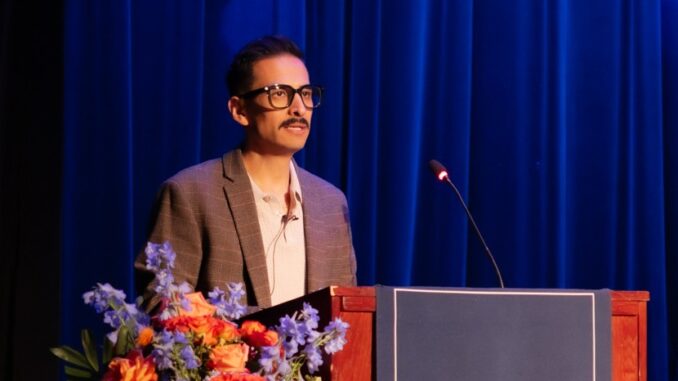
On Sept. 17, award-winning author and poet Marcelo Hernandez Castillo addressed Dominican University students, in a speech based on his book, Children of the Land, as well as share his experience as a formerly undocumented author and educator.
The event celebrated Hispanic Heritage Month, the university’s 125th anniversary, 15th year being federally designated as a Hispanic-serving institution, and its ninth year as a sanctuary campus. It was hosted by the PASOS Network, in collaboration with the Office of Hispanic-Serving Initiatives and the St. Catherine of Siena Center.
He opened the evening with a passage from his memoir, Children of the Land, where he discussed his mother’s self-deportation and the emotional impact of visiting her home in Mexico.
“I will–soon learn the price, the real price of distance,” Castillo read. “I will soon learn exactly what it means to be away.”
Castillo then read his poem, “Enhanced for Removal.” He explained that the title is an official immigration enforcement term coined by former acting ICE Director Todd Lyons, who believed immigration enforcement should be efficient
“like Amazon Prime, but with human beings.”
“You return a package. You remove a person,” Castillo recited. “The difference between return and remove is that one is made out of paper and the other one moves.”
His keynote speech transitioned into a Q&A session, where he was asked how colleges and universities can support undocumented students.
“They don’t have to reinvent the wheel–they just have to ask–the students, “what do you need?” Castillo said. “Had somebody told me that–I would have said– I need a way to get to school.”
He also revealed the title of his next book, What a Shame. He explained that the book explores his sobriety journey as well as his internal struggles with guilt and shame associated with legal status and success.
“It felt–guilty to experience joy, to create, to write,” Castillo said. “This next book–was originally called ‘Guilt’ and now it’s called ‘Shame’–but I think it’s my way of forgiving myself for blaming myself for a lot of things–that weren’t my fault.”
He explained how learning to experience joy without guilt or fear has required the dissection of years of survival instincts.
“So really this idea of joy, it just feels–strange,” he said. “–After eight years of–clarity and recovery–I’m just now learning how to not wait for another shoe to drop–like, good things can just happen.”
To end his speech, he challenged traditional ideas of belonging.
“I have no loyalty to a nation state–only the people who live in it,” Castillo said. “–For me, home is a verb, not a noun.”


Be the first to comment