
By Reyna Valencia
As the semester progresses, many students are unhappy with food prices, availability and variety at Dominican and are turning to other options.
University officials point to inflation-fueled rising food prices nation-wide, and say that they are trying to improve other aspects of food service.
Sophomore Diana Lopez said popular items at Crown Cafe often run out quickly, limiting students’ choices.
“They [Crown Cafe] used to have like a bunch of options for people to eat. There was wings, pasta, and sushi. When they do have it, it usually runs out really quick,” she said.
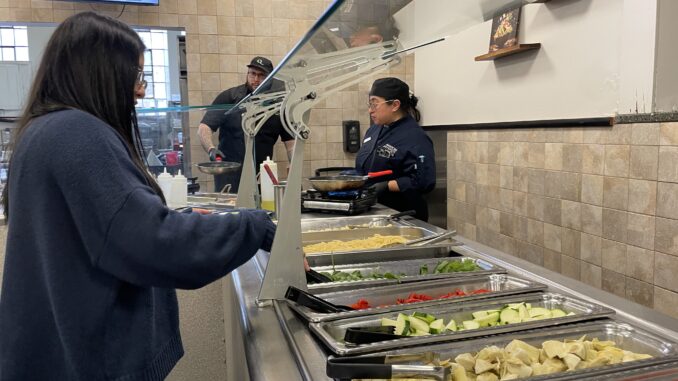
Students also were unhappy about food running out in the Dining Hall. Dominican official Mark Titzer said there is no food shortage, but food trays occasionally empty during busy periods and are refilled as quickly as possible.
Dominican’s Michelle Backus, who works with Quest, said Crown Cafe and dining services are also feeling the effects of rising food costs and other market conditions.
The U.S. Department of Agriculture forecasts that food-away-from-home prices will increase by 3.5% by the end of 2026 compared to 2025.
Ashlee Moraga, a second-year student, expressed her dissatisfaction with dining prices,
“Just communicate and clear the air out because tuition is going up so where is our money going?… We want to see dining with better quality food and variety. We live here, and I feel like we should have that privilege of eating food that we feel comfortable with.”
Going into the 2026-27 academic year, dining services reviewed food prices at nearby schools, including Concordia and Elmhurst University, to determine meal plan rates, she said. See Graph A and B.
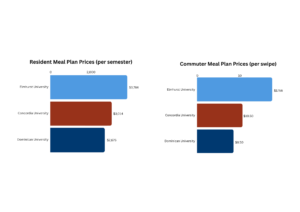
Dominican University offers the lowest resident meal plan and commuter swipe price among the three, Backus said.
“For comparison, the commuter meal plans at Elmhurst University and Concordia University cost between $10.25 and $13.00 per meal swipe.”
Quest Food Management Services met several times with Dominican’s dining services team over the summer to build the cost of menu items. Quest manager Connie Chambers declined opportunities to comment.
In the 2025-26 school year, the dining hall meals with a STAR card/ID ranged from $7.50 to $8.50, and meals without a STAR card/ID ranged from $9.00 to $11.00.
This year, dining hall meals with a STAR card/ID range from $8.50 to $10.00, and meals without a STAR card range from $9.75 to $11.75, according to Backus.
Some students say the issue extends beyond meal prices to the variety of food offered in campus dining.
Lopez points to the limited vegetarian options, explaining that her roommate often struggles to find meals that meet her dietary needs.
“My roommate is vegetarian; she doesn’t get many options, so she struggles a lot… Instead of going to dining and Cyber [Crown Cafe] to get food, she honestly just buys groceries because they don’t have many options for her. And it was yesterday. Actually, she was really happy because dining finally had tofu,” she said.
Moraga and her friends have also turned to alternatives because of their dissatisfaction with the lunch options available on campus.
“We honestly stopped getting dining completely for lunch. We just tend to get cyber or just wait till dinner… a lot of people have been meal prepping at dorms, we kinda just resorted to that, or we get together and order food,” she said.
In response to student concerns, dining services have made changes to some of their offerings, according to Titzer, Dominican Chief Financial Officer. They introduced more cereal varieties and brought back themed Friday night dinners.
He also encourages students to continue sharing suggestions and concerns through the dining hall’s feedback QR code.
“We ask that they please use the feedback QR code, which can be found in the dining hall on the tables, on the screens, and at the register,” he said.



Be the first to comment