
By: Madison DuFresne
While Dominican University’s budget crunch has not affected overall pay, some student workers are still unhappy.
As the school grapples with a $3 million deficit this semester, students may question their job security. Administrators assure student workers that they won’t suffer.
“We’re not going to hit the students with this kind of financial burden,” said Angelique Reda, Director of People Analytics and Systems.
Reda works in the Office of People and Organizational Culture (OPC), but most know them as Human Resources.
Reda explains that student worker funds are delegated at the department level, rather than the university level. According to her, OPC governs the total amount of funding that departments receive. Beyond that point, each department is responsible for their own budget, including how much goes towards their student workers. The number of hours available is based on what the department can afford to spend.
Department budgets change often from month to month, but none have plans to cut back on student worker hours.
However, students face trouble obtaining hours in some offices.
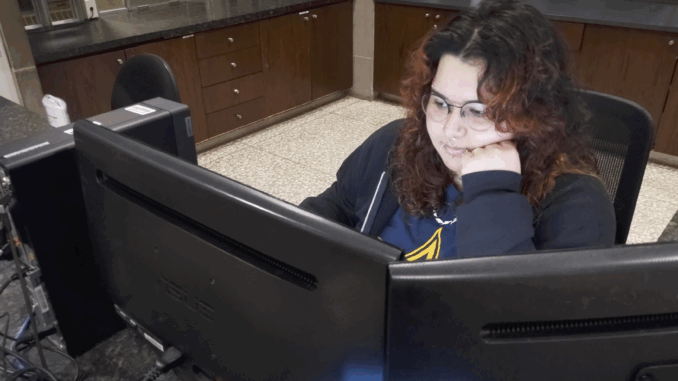
Angel Flores, a student at DU, noted that the problem has progressively worsened throughout their three years working on campus. They began working at the Student Involvement Resource Center (SIRC) when their hours at the Welcome and Information Desk (WID) declined, but this year, Flores is only getting 5 hours a week between both jobs. “It’s ridiculous, it’s not livable” Flores expressed frustration over past years. To compensate, Flores recently began a third job off campus.
Some of the student workers most affected by the issue are those like Flores at the WID.
Mary Sadofsky and Maria Zarco oversee the WID and realize that students want more hours.
While Sadofsky and Zarco work on balancing department needs with worker needs, they encourage students to take advantage of the supplemental options available to them, such as picking up called off shifts and working events and guest visits. But they recognize that these options may not be enough. In such cases, the supervisors recommend communication. “If they have concerns, we definitely encourage them to connect with us. Let’s work together.” Sadofsky said, “It may not be immediate, but we can find a solution as we go forward.”