
By: Jupter Jones
I love using AI, I use it all the time. That’s something you or someone you know probably thinks. The average college student uses AI to spell check, correct grammar, and generate ideas. But do you know the risk that comes with using AI for your assignments? The risks vary, from affecting you as a person mentally, to affecting you physically as a human being. I hope by the end of this reading, you can come to understand the risks you’re taking by using AI, and you can decipher if you wish to continue.
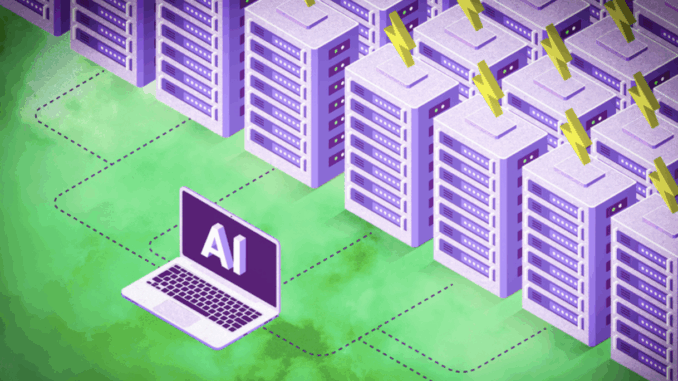
Let me break down AI for you. Think of AI as a computer case, filled with all of the inner parts that need a fan to keep cool while running. A data center that holds a computer case, holds multiple, maybe thousands of them. With so many computer cases, they all need to be cooled, so how can that effectively be done? By using fresh water from the surrounding communities, the same water that we use to drink and shower with. That water cannot be regenerated. Norman Bashir, a Computing and Climate Impact fellow at MIT, has said, “Chilled water is used to cool a data center by absorbing heat from computing equipment. It has been estimated that, for each kilowatt hour of energy a data center consumes, it would need two liters of water for cooling.” In the end, that’s water that could be used for consumption, showering, or even boiling a pot of tea. This is something we currently don’t pay for right now, but eventually we will. It’s harder to imagine having to live in unideal circumstances, so let’s see how this affects other citizens in America.
In the South of Memphis, Elon Musk’s data center is currently polluting the air with ‘smog-producing nitrogen oxides.’ Residents say that the air reeks of gas, and sometimes chlorine. These residents are also experiencing a lack of clean tap water to brush their teeth with or even drink from. Parallel to an issue we’ve been seeing in Detroit, Michigan for years. AI Data centers won’t stop with Musk and Memphis, as there’s been talk about introducing a center to Chicago. If this does occur, every AI search will contribute to the reason why citizens in Chicago cannot consume tap water. Then this issue won’t be something that just affects people we don’t know, it will affects our neighbors and us. I remember when everyone freaked out over covid and bought a massive amount of water bottles, and there’s the irony of that possibly happening again.
Aside from water pollution, there’s also energy consumption. Shaolei Ren and Adam Wierman from Harvard Business Review have stated, “…A single AI model, such as a large language model, can consume thousands of megawatt hours of electricity and emit hundreds of tons of carbon. This is roughly equivalent to the annual carbon emissions of hundreds of households in America.” Our energy use is already nearing a dangerous rate, but with the use of billions of people using AI, we can expect to see this rate increase. I will end this section of environmental harm with a quote from Ren and Wierman, “The generation of electricity, particularly through fossil fuel combustion, results in local air pollution, thermal pollution in water bodies, and the production of solid wastes, including even hazardous materials.” The Earth isn’t just ours to live on, we share this planet with animals, insects, fish, and other living things. Our actions and contributions to climate change affect these living beings when they can’t even comprehend the harm.
As a student studying education, the discussion of AI use in the classroom has been held multiple times. We’ve discussed what pros and cons can occur for students, and for educators. I’d like to present to you, as a student, the fact that technology will decline your critical thinking skills. You will forget adjectives, nouns, and verbs you were taught in school (and that’s just starting small). Every time you have a question about something, you might reach out to AI, but it isn’t a credible source to receive your information. AI can be changed to say whatever at any time and changes its responses to better suit you. That does not scream a credible source for college students to be receiving their information from! My opinions aside, I hope this mini article has helped you understand what risks come from using AI, and you can decide from here how you wish to continue your relationship with it.