By: Bella Bercan
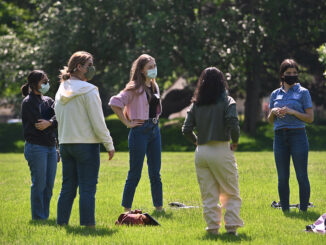
As Fall semester comes to a close with Thanksgiving passing us by, conversations surrounding Indigenous history became more prominent on campus with the Indigenous Club hosting an Indigenous People’s Day meal and later holding a screening of “The Lakota Nation v. the United States.”
Dominican students in the Indigenous Club are trying to set the record straight not only on Thanksgiving but also on most American history. The film “The Lakota Nation v. the United States” shares the ongoing struggle facing Indigenous people in the Dakotas.
Only 0.2% of Dominican – 4 students – are Indian/Alaskan Natives as of Fall 2025, but they have an important perspective and a powerful story to tell, according to Kaylanah Strange Owl from the Northern Cheyenne Nation, the club’s president. “It was important to create this club…and bring Indigenous identity to Dominican,” she said, “As an Indigenous student, I didn’t see a lot of that here.”
“Dominican University states that it strives to support and celebrate all cultures, and the Indigenous population, though small, believes they deserve to have their traditions and cultures shared with the rest of the community,” said Santi Brito, a member of the club.
“I feel like something that Dominican could do a lot more is just simple exposure…work with the local indigenous communities here to perhaps make it a well-known fact whose land we reside on, as well as perhaps inviting some indigenous leaders to campus to speak,” he said. “Because it’s really important, as a Catholic institution who’s occupying Indigenous land, it should be important for us to acknowledge whose land we’re on.”
He went on to suggest more courses highlighting indigeneity, indigenous literature, history, indigenous art, and the politics of indigenous people here in the Americas. He states, “also…educating the students on what indigeneity is and how it’s kind of developed over time.”
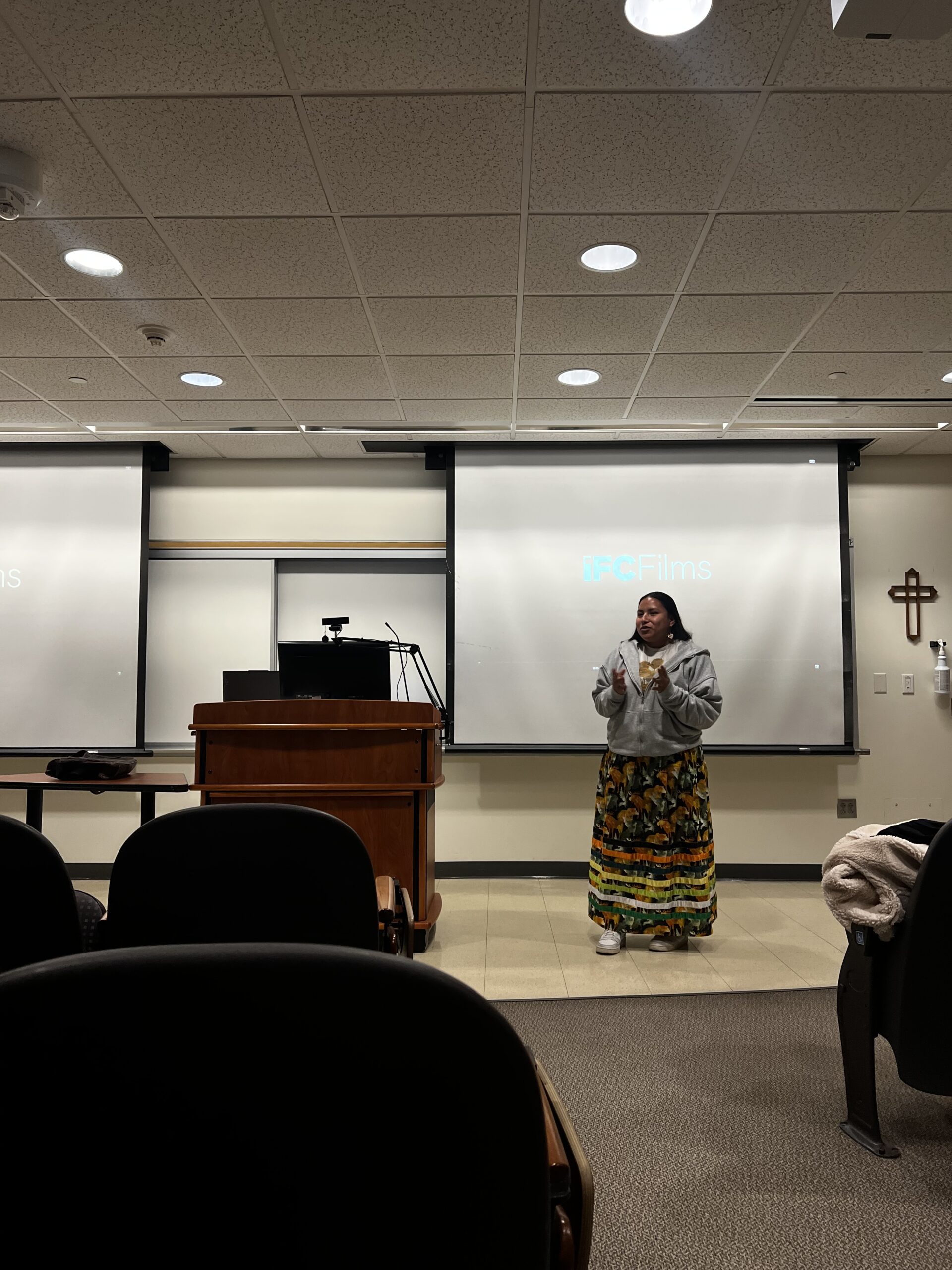
About 15-20 students – club members and guests – were on hand for the club’s most recent event, the film showcased first-hand accounts of the continuous mistreatment of the Lakota Nation, and the theft of their land. It focused specifically on the South Dakota Black Hills, a sacred site for the Lakota and famously known for Mount Rushmore showcasing George Washington, Thomas Jefferson, Theodore Roosevelt, and Abraham Lincoln. The film was broken up into three parts: Extermination, Assimilation, and Reparation. “The entire film was powerful and important to show,” according to Strange Owl.
“It holds a lot to my heart because right now my very own home is going through something with nuclear waste management, and we’re trying to fight that,” she said, “It helps me know that if your community puts their mind to it, you can save your land, save your ways of life. And a lot of people should know that we borrow this land. This land isn’t ours to own. And in a lot of indigenous proverbs, that’s what it is. We come from this land and we’re going straight back to it. We’re just borrowing it. It’s not ours to keep.”
The film as, previously stated, highlights the hardships these nations face, which date back to the “discovery” of this land by English settlers and the notorious 1621 feast, a shared meal between the two groups which was followed by the 1637 massacring of the Pequot people marked as the “Day of Thanksgiving”. Kaylanah spoke about this saying, “of course, you can still eat…with your family, but we also need to acknowledge that that’s not what it’s celebrating. It’s not celebrating something peaceful. It’s essentially just putting a cover on something that shouldn’t even be covered up.”
The Indigenous club is here to highlight these truths, but they also strive to share Indigenous joy, member Caitlin Herrera states, “I think there’s a lot of joy in these communities. And I think I want to highlight that even though many of our communities have been through a lot of hardship, there’s still always something to smile about.”
The Indigenous club wants Dominican students to know, Herrera says, “that people are always welcome to come educate themselves…come and learn, and come with humility, and understand we’re not going to say you said something wrong. We’re here to help educate and let people know about Indigenous identity in the U.S. because we’re all, like Santi said, we’re occupying somebody else’s land…we’re hoping to be that space, a space for dialogue on Indigenous matters,”
The Indigenous club welcomes all Dominican students. Members expressed the hope that the events shared this fall will initiate more learning and conversation regarding Indigenous history beyond the Thanksgiving season.