
By David Lazzara
With the economy being all over the news, the last thing students want to hear is that their university is raising tuition for next year.
Dominican has actively raised its tuition over the last five years, causing students to be surprised when they realize they need to pay more. Sophomore Edhem Planincic said, “I pay for my own schooling, therefore, when fees increase, it impacts me personally, since it puts more stress on me to make sure I have enough money to pay for school.”
While the tuition increase can be frustrating, students have the ability to see next year’s cost on Dominican’s own website well in advance, giving students time to plan accordingly. Elaborating on the timeframe is Mark Titzer, the Chief Financial Officer. “They are usually approved at the October board meeting; these should have been on our website in November.”
This is especially useful for the upcoming school year as Dominican is raising its tuition by $600 per semester.
Another concern raised by students is how tuition for each year is calculated. Students like senior Kevin Ruiz expressed how there are many factors that go into the cost, but without adequate explanation, “There’s no way for us to control these factors, so we are responsible for the increase without knowing. At the very least, [Dominican’s Business Office] should have people able to answer questions.”
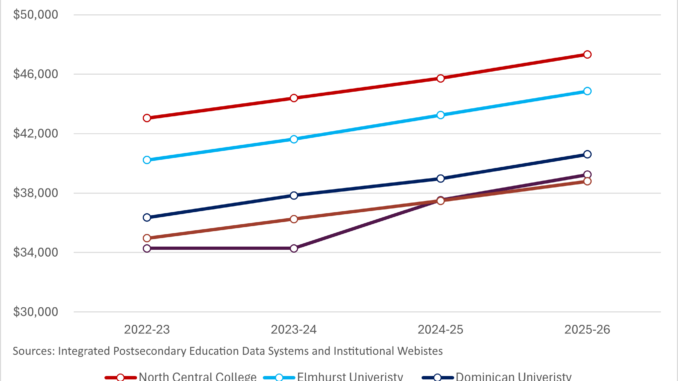
The Business Office undergoes a thorough process in determining such costs. For example, it researches the tuition of neighboring or similarly equivalent universities. “The thing that drives it the most is the competitive landscape,” Titzer said. “We look at other universities that have a lot of cross-application or cross-admission, generally looking at the competitive landscape and where their sticker prices are.”
As seen in the chart above, Dominican aims for a middle ground when compared to other universities. This itself is a tactic more focused on recruitment, but it can also be important to focus on retaining current students.
In recent years, Dominican has seen variability in enrollment numbers. This directly affects the flow of money going in and out of the university and plays into pricing for the next year. “In some years past, when we had much larger classes than we had predicted, the thought was supply and demand; we could raise the price to take advantage of that demand,” Titzer said. “In other cases, like during COVID or where we have experienced some softness in enrollment, we might temper, leave flat, or have a very small increase.”
When tuition does increase, the first question on many students’ minds is where does the extra money go towards. “If they increase tuition, I want to know what it is for,” said Planincic.
Explaining where any surplus money goes, Titzer said, “There are untold needs around the institution that we can spend the additional tuition dollars on, whether it’s facility improvements or additional staff. The nice thing about being non-profit is really anything that is in excess goes right back to the institution to make buildings nicer or to offer more services to students.”
For more information on Dominican’s tuition prices and fees, visit the Tuition, Fees, and Expenses page on Dominican’s website or use this link: https://www.dom.edu/offices/student-accounts/tuition-fees-and-expenses



Be the first to comment