By: Isabella Bercan
As fall settles in, there are things that students either enjoy or loathe; the days grow colder, the dark of night comes earlier, and choosing whether to take a class in-person or online.
An informal survey in early October showed that most of the undergraduates we spoke to prefer in-person classes.
“I cannot work and learn through a computer; my success happens when I am in a classroom,” one surveyed student said.
Dominican and the rest of the world shifted totally online with the pandemic and has been gradually coming back. Most recently, the survey done on campus resulted in 50 students preferring in person and 10 who preferred online.
“I prefer in-person classes because I learn more effectively with my peers,” one student said. “The times I had online classes it was really hard to communicate with the professor.”
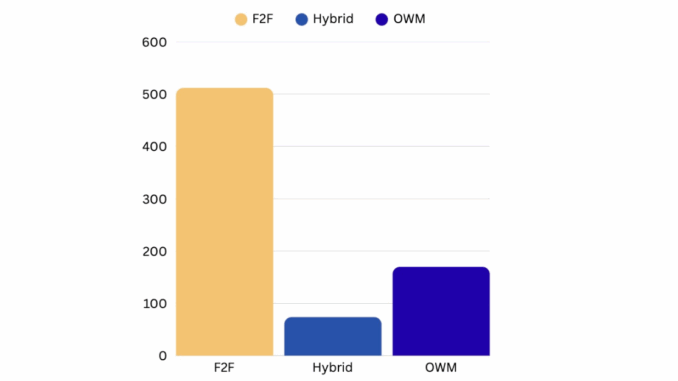
As of fall of the 2025-2026 school year, 512 courses were face-to-face (63.8%), 74 were hybrid (9.2%), and 170 were online with no meetings or asynchronous (21.2%) according to Senior Director of Institutional Research Elizabeth Silk. Taking in the significant difference between F2F and OWM, is Dominican properly balancing these options regarding students’ preferences and needs? Chad Rohman, dean of the Rosary College of Arts, Education and Sciences said,
“Ideally, we have a healthy balance of modalities both across the college and within each discipline,” he said.“However, we strive to have a healthy percentage of in-person (F2F) and/or hybrid courses, given our relationship-centered ethos.”
Professors also have their preferences, mainly based on the nature of the class, said, Mickey Sweeney, English professor and president of the faculty Collegium, which represents Dominican faculty.
“So what considerations are taken into account when it comes to the modality of a class?” she said. “What works best for the students, given the course material? Is this kind of course best conveyed online or in person? In my opinion, there are some classes you cannot, or better said, should not do online.”
“The needs of the department should also be considered and the policy of the school,” she said. “Mostly, I think I would say predominantly the needs of the student in terms of how this learning happens has to be considered. As circumstances change in the world around us, we also have to be aware of how needs change and we have to have policies that can take that into account.”
Dominican prides itself on being accessible and pushing students towards the pursuit of truth, compassionate services, and taking part in a more just and humane world. To accomplish this mission, the success of the student must be put first, and success may look different from student to student.
“…if there are students (or faculty and staff) who need to be online, then we need to have an online community. If there are students, or faculty and staff who achieve that by being in person, then of course, we need to do it in person as well,” Sweeney said.
Space considerations are also a factor, according to Rohman.
“Faculty often determine their modality, given the nature (or topic) of their course—and the size of the class,” Rohman said. “Art courses are in person, ordinarily, for example. STEM labs are in person, too, while didactic sessions may be both in person and online, depending on that particular section.
“However, given the classroom shortages, we may need to be creative in considering the traditional use of all of our teaching spaces,” he added.
“Every time I walk onto campus it allows me to focus in and do the best I can. One third-year student said. All the teachers and staff I see every day give me the strength to work harder because I know they are giving their best to us each day; that is something I do not get online.”