By Santiago Leon Torres
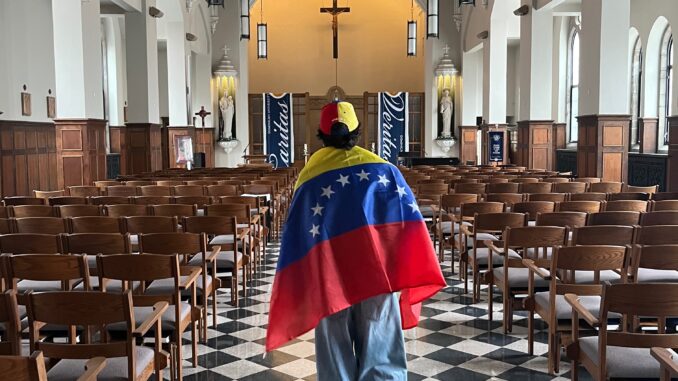
Freshman student Richard Medina was at home, in his room when he heard the news he’d been waiting for all of his life. It felt like any other day until his dad burst into his room, “They’re bombing Caracas!” hesaid. Shortly after, in the early hours of Jan. 3, 2026, President Trump announced that the US had captured former Venezuelan President Nicolás Maduro.
Medina had formerly grown up in Venezuela.
“Obviously, I have always been hopeful that I would see a free Venezuela, but I wasn’t expecting it to be that moment,” Medina explained. “The truth is that it took me completely by surprise. I had even given up hope of action in the short-term. I thought it was going to be ten, maybe more years to see Venezuela with a different government.”
For many people that experienced Venezuela’s authoritarian government, the news came as a relief. Professor Ricardo Andrade Fernandez, an assistant Spanish professor, was awake during the raid, but did not catch wind of the news till the following morning.
“It was a shock because I didn’t know that I would be witness to some tiny form of reparation for all the victims he had,” Andrade Fernandez said. “I wasn’t sure I was even going to live long enough, even though I am way younger than Maduro.” Despite the satisfaction he gained from seeing Maduro captured, Andrade Fernandez still has his doubts.
“You have some very tiny hope that things can happen in favor of democracy. But at the same time, you are quite sure that they are so empowered and so in control of all the institutions, of all the weapons,” he said.
Andrade Fernandez also noted the mixed feelings derived from receiving the news abroad, away from his country.
“Exiled people cannot be fully happy, ever, probably because we have been severed from a critical part of our minds, our hearts, and memories,” He acknowledged. “How do you put it into words? It’s like being amputated– emotionally amputated. It’s hard to live with that void all the time. Of course you try to adapt. Of course, you try to evolve and grow professionally and with your family, but you are always broken to some extent. So, getting news from home, it’s always bitter.”
People do not just uproot their entire lives and leave their families and friends behind for no reason. Leaving Venezuela was not Medina’s decision, but he still reflects upon it regularly.
“We left because they were looking for us. The police from our city were threatening us.” Medina admitted.
Besides Medina’s precarious situation involving the police, there are many other reasons for the influx in migration from Venezuela in recent years.
“Normally, the line to get gasoline took about three days to get through. What my dad would do was get in line with his car, turn it off, and walk back home. He then waited the two or three days it took to for the fuel tanker truck to get to the gas station.” Medina explained. “There were times we had to get gas from outside sources. There were scalpers who would fill up their car, siphon it, and sell it, at a higher price, obviously.”
Gasoline was not the only scarce commodity in Venezuela.
“Buying groceries became a legal procedure. You had to have your government ID to purchase food, and that wasn’t a rule a few years before I left.” Medina said. “Everything was tightly controlled. If you bought groceries at one store, and went to the next, they would turn you away if they saw the bag of food in your hands.”
For many Venezuelan citizens like Medina, blackouts were not an oddity, they were to be expected.
“I remember, three to five times a week, the power would go out for four to six hours. Those days were complicated.” Medina recalled. “Obviously, when I look at it from here, with some retrospection, the lack of electricity, water, and natural gas was so surprisingly normal in Venezuela.”
With such drastic measures taken to remove Maduro from power, some people may ask themselves how he got there in the first place.
“One important thing that we have to remark on is that Maduro wasn’t a legitimate president.” Andrade Fernandez asserted. “In 2024, the Venezuelan people voted overwhelmingly for Edmundo González Urrutia, under the leadership of María Corina Machado, clearly rejecting the continuation of the regime, rejecting the continuation of violence, of state-sponsored terror.”
Unfortunately, the outcome of a democratic election was not enough to stop the regime.
“González Urrutia won by about thirty points, so it was a landslide,” Andrade Fernandez explained. “However, the government simply invented a result in favor of Maduro. They just declared that Maduro was the winner without releasing any disaggregated results.”
Following the election, Maduro’s illegitimate presidency was nothing short of terror, particularly if you chose to speak up against the regime.
“During the protests, many people died,” Medina said. “In Venezuela, there are around 1,200 people who have been kidnapped by the government illegally for supporting the opposition. They were labeled terrorists and traitors to their country. I have known many people who were kidnapped and well, unfortunately, they were disappeared in the fight for their country.”
Many people condemn the involvement of the United States regarding the capture of Maduro. Others saw his fall as inevitable, meaning the US was just the country that happened to do something.
“From a Venezuelan’s perspective, Maduro’s capture is the result of many years of inaction, many years of indifference, and many years of double standards from governments and from international organizations as well, that did very little or nothing for the Venezuelan people,” Andrade Fernandez expressed. “Of course, no one wants to see bumps on our own soil. That’s terrifying. That’s undesirable. The Venezuelan people do not rejoice because it is America who removed Maduro, but because they feel like they finally have a fighting chance.”
“The truth is that Venezuelans have tried everything. When I say everything, I mean everything. I mean elections, dialogue process, all of them fail,” he asserted. “The dictatorship response has always been the same–violence, state killings, imprisonment, torture, ignoring the popular vote and systemic human rights violations that are very well documented by the United Nations reports and other organizations.
Andrade Fernandez admits there are a lot of factors at play and that the solution is not simple.
“There’s much to be done, and that was a necessary step towards transition, towards democratic transition, but… we are still in a very early stage towards that. The dictatorship is still in place as well. We can talk about the procedure, and we can have many opinions about the way it was done, but emotionally speaking it was joy. It was relief,” he said, “It felt like a bridle of hope amid all the darkness.”